
Battles - The Third Battle of the Aisne, 1918
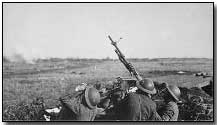 Whilst the first two battles of the Aisne were conducted by Allied forces,
predominantly French, against the German army in France, the Third Battle of
Aisne, from 27 May-6 June 1918, comprised the final large-scale German
attempt to win the war before the arrival of the U.S. Army in France, and
followed the Lys Offensive in Flanders.
Whilst the first two battles of the Aisne were conducted by Allied forces,
predominantly French, against the German army in France, the Third Battle of
Aisne, from 27 May-6 June 1918, comprised the final large-scale German
attempt to win the war before the arrival of the U.S. Army in France, and
followed the Lys Offensive in Flanders.
The focus of the offensive was the Chemin des Dames Ridge, held by the Germans upon their retreat from the Marne in September 1914 until their ejection, at huge cost to the French, during the Nivelle Offensive, also known as the Second Battle of the Aisne, in April 1917.
Erich Ludendorff, although subservient to Paul von Hindenburg within the German Third Supreme Command, effectively dictated the planning and execution of the German war effort. He determined to reclaim the Chemin des Dames Ridge from the French with the launch of a massed concentrated surprise attack. In so doing he anticipated that the French would divert forces from Flanders to the Aisne, leaving him to renew his offensive further north, where he believed the war could be won.
At the time of the offensive the front line of the Chemin des Dames was held by four divisions of the British IX Corps, ironically sent from Flanders in early May in order to recuperate. General Duchene, commander of the French Sixth Army, was responsible for the continued defence of the sector, and Lieutenant-General Sir Alexander Hamilton Gordon, commander of IX Corps, was required to place himself under Duchene's direction.
Thus, when Duchene decided to send the British divisions to the front line, Hamilton Gordon, although reluctant to see his fatigued troops further exposed, was obliged to dispatch his men forward. He however recommended to Duchene that a policy of defence in depth be adopted for the eventuality of an attack. Duchene disagreed, preferring to mass troops in front-line trenches.
The attack was launched early on 27 May with a ferocious heavy artillery bombardment of 4,000 guns across a 40 km front, against four divisions of IX Corps. Owing to the heavy concentration of primarily British troops in front-line trenches, casualties from the bombardment were severe; IX Corps itself was virtually wiped out. The bombardment was accompanied by a gas attack, designed to disable defensive gun crews, after which 17 divisions of German infantry, under Crown Prince Wilhelm, began their advance through a 40 km gap in the Allied line.
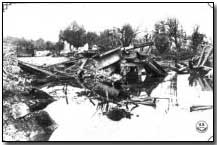 With
the Allied forces entirely taken by surprise, the rapid progress of the German troops was reminiscent of the more fluid war of movement of the
opening months of the war.
With
the Allied forces entirely taken by surprise, the rapid progress of the German troops was reminiscent of the more fluid war of movement of the
opening months of the war.
Between Soissons and Reims the Germans broke through a further eight Allied divisions, four British, four French, reaching the Aisne in under six hours. By the end of the first day the Germans had gained 15 km of territory and had reached the River Vesle. By 30 May the Germans had managed to capture 50,000 Allied soldiers and 800 guns, arriving within 90 km of Paris by 3 June.
Once again a German victory seemed probable. However, as before, problems with supplies and reserves, and troop fatigue, in addition to prolonged Allied counter-attacks, halted the German advance at the Marne. By 6 June the German advance had run out of steam.
French casualties were heavy, with 98,000 losses; their British allies suffered 29,000 casualties. General Duchene was dismissed by Petain, amid an atmosphere of crisis in Paris. Petain's own position was placed under threat, with his role being made subservient to that of the recently promoted Allied Supreme Commander, Ferdinand Foch.
Click here to view a map charting the progress of the battle.
Photographs courtesy of Photos of the Great War website
Observation balloons were referred to as 'sausages'.
- Did you know?

.jpg)